Precision for an Intelligent Inspection Future—An In-Depth Look at Automated Warp and Weft Density Inspection Equipment for Electronic Fabric
As the electronics industry evolves rapidly, electronic fabric is the structural backbone of copper-clad laminates and printed circuit boards (PCB). Its quality directly determines the reliability and stability of advanced equipment such as 5G communications systems, new-energy vehicles and AI servers. Warp and weft density, a fundamental structural parameter, directly affects tensile strength, insulation and resin impregnation. The shortcomings of manual inspection have become a bottleneck in the development of electronic-fabric manufacturers. Automated warp and weft density inspection equipment rebuilds the quality-inspection system with intelligent, precise and efficient solutions, providing new momentum for high-quality industry development.
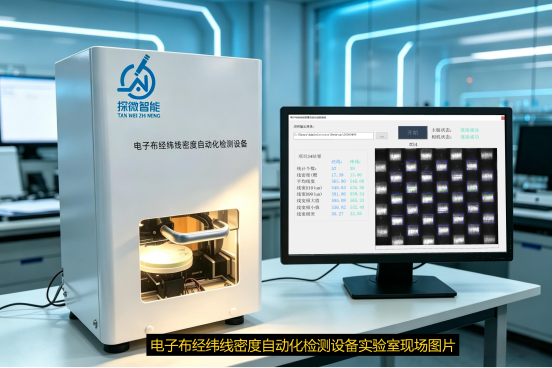
Industry Challenges Make Intelligent Inspection Essential
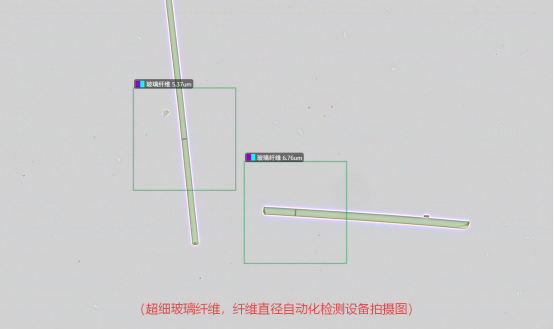
Electronic fabric is precisely woven from ultrafine glass-fiber yarn whose filaments are only a few micrometers in diameter. Inspection of its three core parameters—warp and weft density, finished width and gap area—is essential to quality control. The industry has long relied on visual counting and pick-glass observation, with several persistent challenges:
• High error rates and substantial quality risks: Visual fatigue and differences in operating technique can cause missed inspections and incorrect judgments. Warp and weft density errors are difficult to control, and hidden defects such as deviations in gap area and width may not be found promptly. These can cause delamination, blistering and signal attenuation in downstream PCB products, or customer claims, with losses of hundreds of thousands of yuan or more per incident.
• Low efficiency that cannot support mass production: Manual inspection takes several minutes per electronic-fabric sample, achieving only one-tenth of automated equipment’s efficiency. Comprehensive quality control is difficult, and entire batches may have to be scrapped.
• Scattered data make traceability and compliance difficult: Manual recording can lead to missing or incorrect entries and cannot produce standardized reports. It is difficult to meet customer factory-audit and industry sampling requirements or provide accurate data for production-process optimization.
• High labor costs and demanding specialist skills: High-precision inspection requires trained quality-control specialists. Prolonged intensive observation can increase staff turnover, raising labor and management costs and making inspection upgrades particularly difficult for small and medium-sized enterprises.
Core Breakthroughs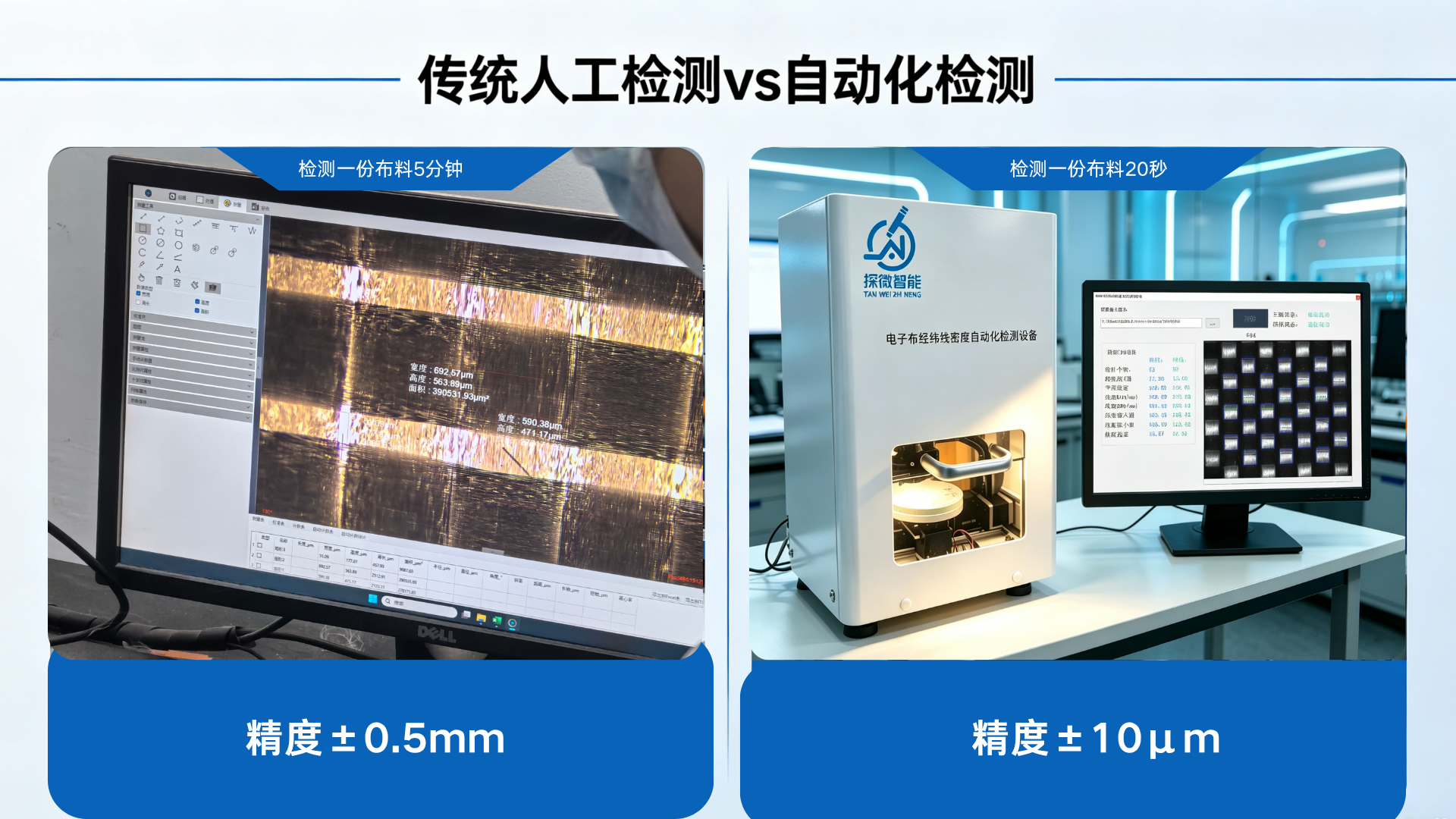 : Highlights of Automated Inspection Equipment
To address these industry challenges, automated warp and weft density inspection equipment for electronic fabric uses machine vision, deep learning and other advanced technologies to deliver a tailored, end-to-end intelligent quality-inspection solution. It moves decision-making from personal experience to precise data. Its principal highlights are:
Highlight 1: Micrometer-Level Precision to Eliminate Hidden Quality Risks
The equipment combines a high-resolution industrial camera with ring lighting to clearly capture the texture of ultrafine glass-fiber yarn with filament diameters below 9 μm. A DoG algorithm enhances image contrast, suppresses interference from fabric background textures and accurately recognizes warp and weft distribution. Inspection precision can reach ±0.1 threads/10μm, substantially exceeding manual inspection standards. In addition to accurate warp and weft density measurement, it simultaneously inspects fabric width, gap area and other core parameters. It comprehensively identifies hidden defects such as broken warp, broken weft and uneven density, with a detection rate above 95%, eliminating quality risks at their source and supporting downstream PCB stability.
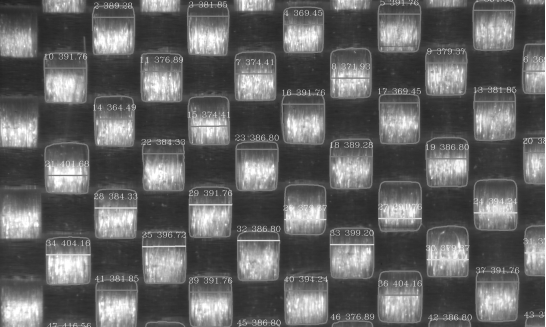
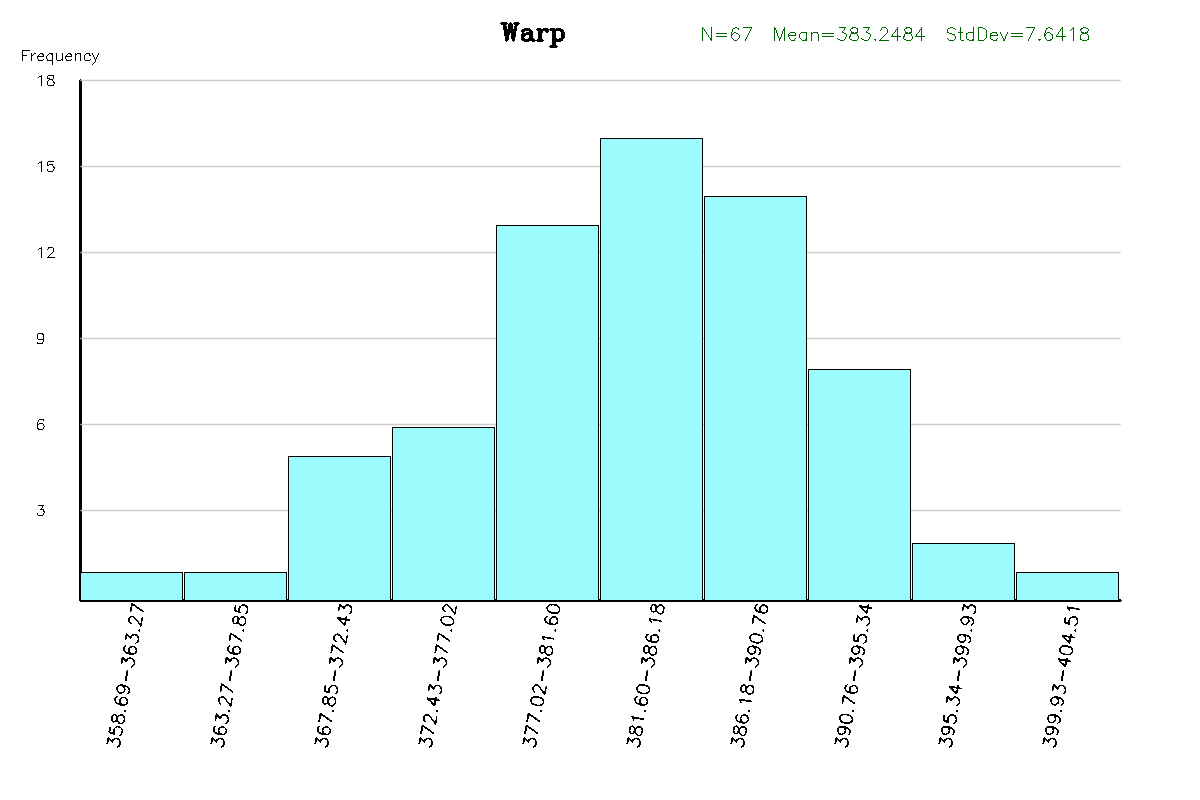
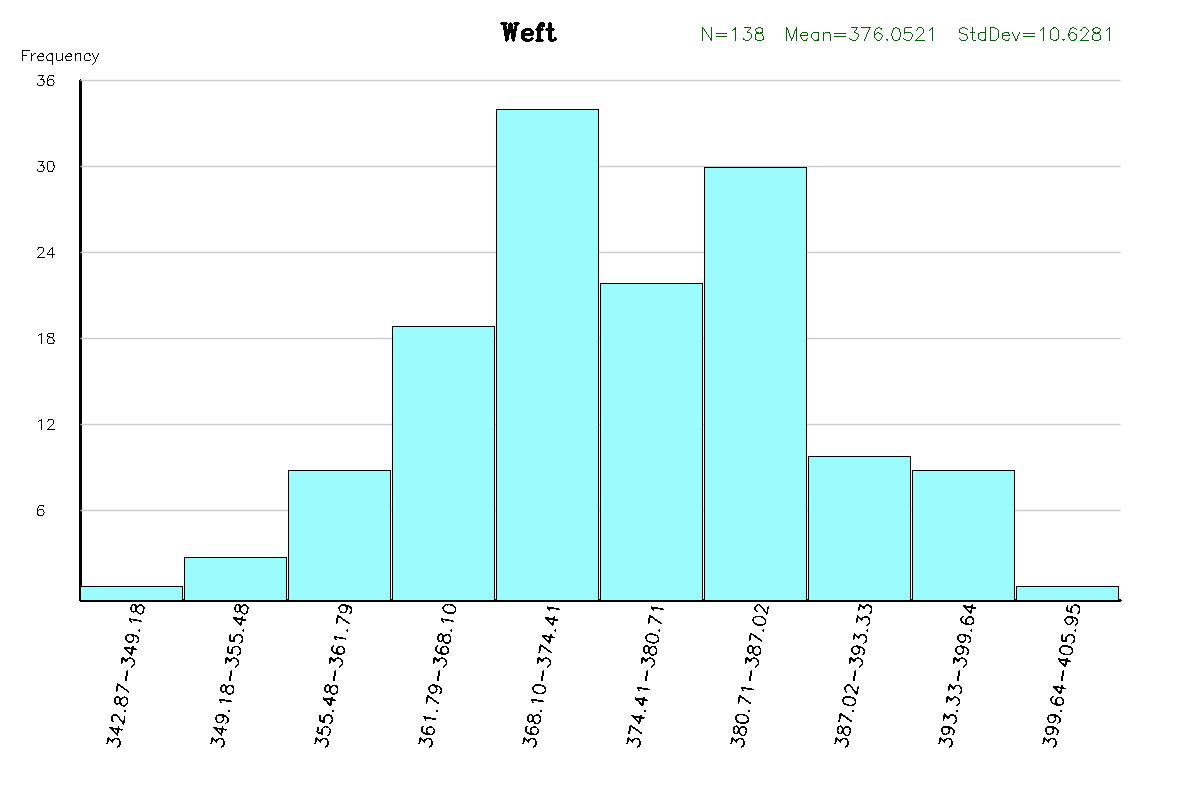
Highlight 2: A Closed Data Loop for Compliance and Process Optimization
The product includes a report-generation system that automatically acquires, stores and analyzes inspection data, eliminating missing and incorrect manual entries. It generates standardized reports complying with GB/T 7689.2-2013 and other industry standards, meeting customer factory-audit and industry sampling requirements. All data can be queried by batch, time, production line and other dimensions to create a product-quality profile. This provides accurate data for process optimization, helps identify the causes of recurring defects and enables lean management through an inspection–analysis–optimization closed loop, continuously improving production efficiency.
Highlight 3: Simple Operation Reduces Labor and Management Costs
The equipment has a user-friendly design and a clear, intuitive interface. Specialist inspectors are unnecessary; ordinary workers can operate it after brief training, reducing skills barriers and training costs. One-touch startup, automatic calibration and automatic inspection reduce intensive visual work and staff turnover. One unit can replace 6-8 manual inspectors and save over 100,000 yuan in annual labor costs. It is particularly suited to inspection upgrades in small and medium-sized enterprises, helping reduce costs and improve efficiency. Its modular design also simplifies maintenance, and parameters can be adjusted flexibly for different electronic-fabric specifications, providing strong compatibility.
Working Principle: The Logic Behind Intelligent Inspection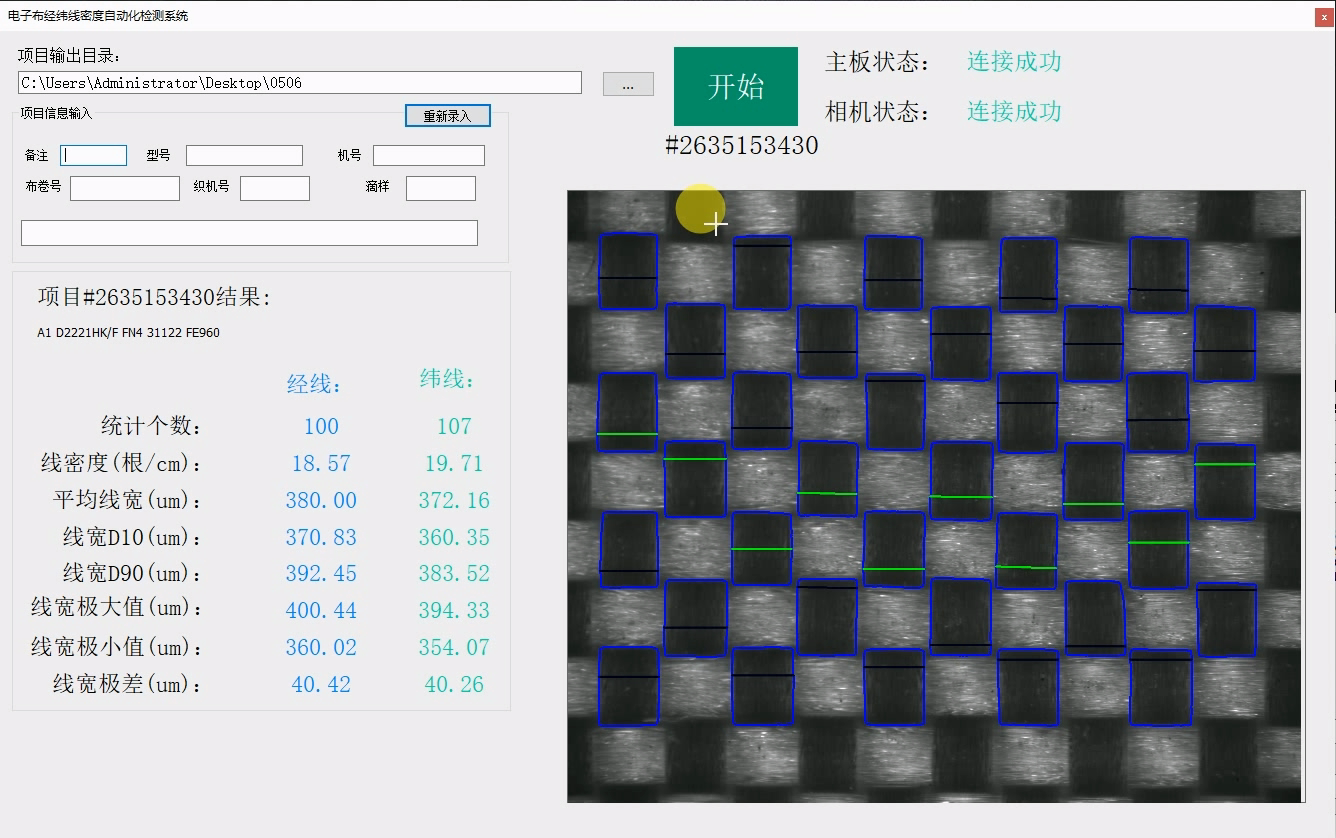
Combining machine vision, image-recognition algorithms and automated control, the equipment provides intelligent inspection throughout the process. Its core workflow consists of three straightforward steps:
1. Image Acquisition: A high-definition camera and dedicated ring lighting acquire comprehensive, high-precision images of the electronic-fabric surface. An encoder simultaneously records fabric length, ensuring complete, stable acquisition and avoiding errors caused by fabric movement or lighting interference.
2. Algorithmic Analysis: Images are transmitted to an industrial computer. DoG enhancement and dynamic threshold segmentation suppress normal texture interference and emphasize yarn features. Deep-learning algorithms then identify warp and weft counts and spacing, calculate density, and identify and locate surface defects.
3. Result Output: After inspection, the system automatically outputs warp and weft density, fabric width, gap area and other parameters and generates a standardized report.
Applications: Broad Industry Coverage for Diverse Needs
With strong compatibility and stability, the equipment supports a wide range of electronic-fabric applications, companies of different sizes and products with differing specifications, including:
• Large-scale electronic-fabric manufacturers: Integration with high-speed weaving lines for comprehensive online inspection throughout production, improving efficiency and consistency and meeting high-end PCB customer requirements.
• Small and medium-sized electronic-fabric manufacturers: A cost-effective replacement for manual inspection that reduces labor costs, enables rapid inspection upgrades and meets compliance requirements.
• Electronic-fabric laboratories and quality-inspection centers: Precise offline inspection for product development, sample testing and quality review, providing data for technological optimization.
• Copper-clad laminate and PCB manufacturers: Incoming inspection of electronic-fabric raw materials to control quality at the source and prevent downstream product losses.
Product Value: Supporting High-Quality Business Development
Automated warp and weft density inspection is more than replacing people with equipment. It rebuilds the electronic-fabric quality-inspection system and provides several core benefits:
For quality, micrometer-level precision eliminates hidden defects, increases qualification rates, reduces claim risks and strengthens competitiveness. For efficiency, comprehensive inspection replaces sampling, substantially increases throughput, supports mass production and reduces batch-scrapping losses. For costs, automated inspection reduces labor and management expenses, shortens inspection cycles and improves cash turnover. For development, a data-based quality system supports process optimization and lean management, helping companies move toward high-end, intelligent and green production in line with the electronics industry’s high-quality development.
As AI computing and edge-computing technologies continue to evolve, the equipment will further develop multimodal inspection, accurately recognizing internal and material defects and advancing from appearance inspection to performance prediction. It will continue supporting electronic-fabric manufacturers, protecting quality throughout the PCB supply chain and building an intelligent inspection future.