New National Standard Takes Effect in August: Fiber Diameter Inspection Enters the Digital Optical Scanning Era—How Should Electronic-Grade Glass Fiber, Mineral Wool and Ceramic Fiber Wool Manufacturers Respond?
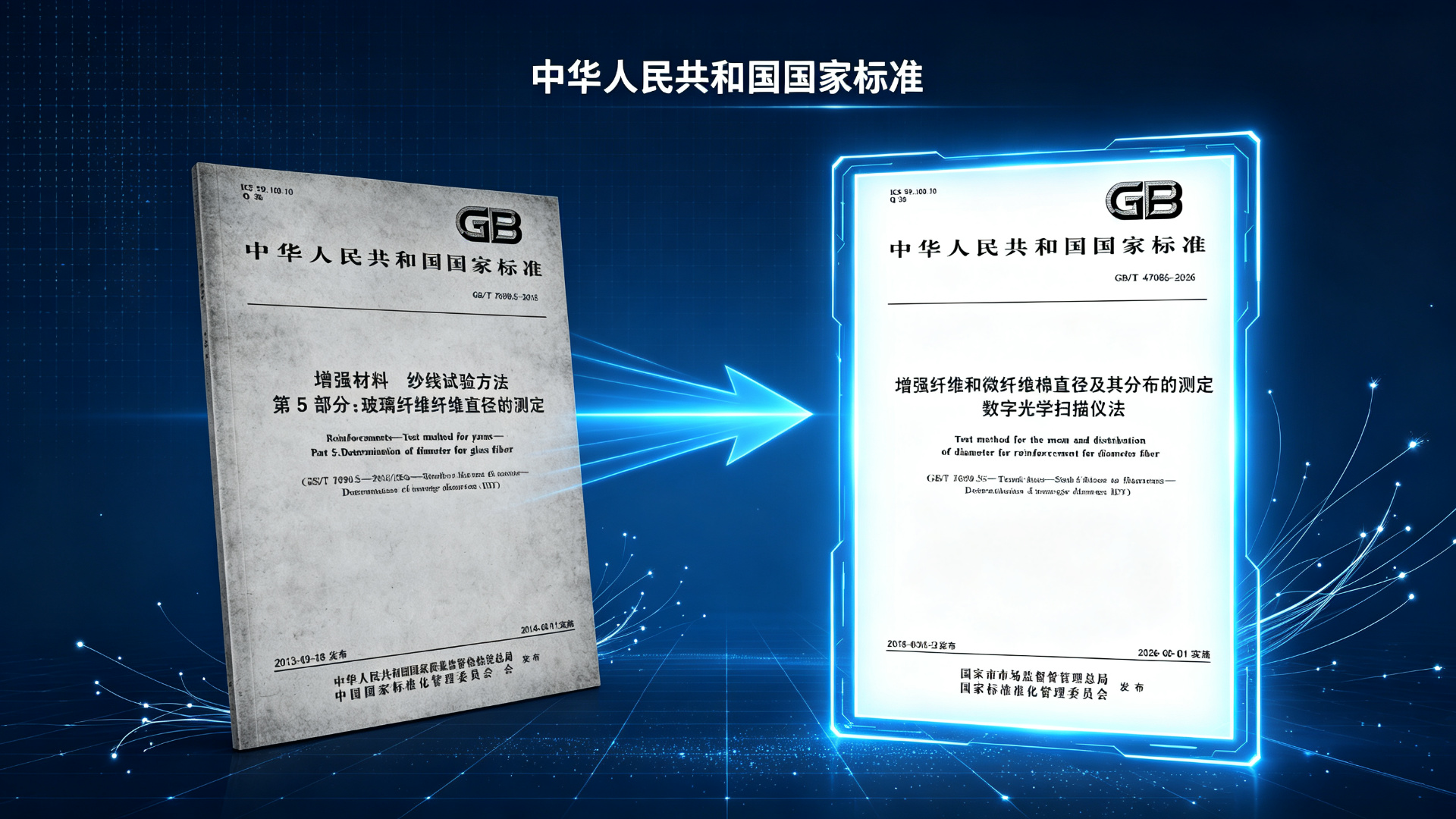
On August 1, 2026, GB/T 47086-2026, Reinforcing Fibers and Microfiber Wool—Determination of Diameter and Its Distribution—Digital Optical Scanner Method, will officially take effect. Manufacturers of electronic-grade glass fiber, mineral wool and ceramic fiber wool, whose diameter-precision requirements are stringent, are already placing inspection-equipment upgrades on their agenda.
Inspection Challenges in High-Precision Fiber Production
Fiber diameter is a key quality indicator in the electronic-grade glass fiber, mineral wool and ceramic fiber wool industries:
Electronic-grade glass fiber: Diameter deviations directly affect electronic-fabric thickness uniformity, dielectric performance and PCB-substrate quality. Electronic-grade products such as D90 and G75 yarn have extremely strict diameter tolerances;
Mineral wool (rock wool/slag wool): Diameter distribution determines shot content, thermal conductivity and insulation performance and is a core control parameter for product compliance;
Ceramic fiber wool: Diameter affects temperature resistance, thermal conductivity and flexibility. Ultrafine ceramic wool requires even higher diameter-inspection precision.
However, the manual microscopic measurement method long used in the industry has clear shortcomings when addressing these high-precision needs:
Limited Accuracy—The Inherent Limitations of Visual Readings
Under GB/T 7690.5-2013, inspectors measure individual fiber diameters under a microscope using an eyepiece micrometer, randomly measure 25 fibers and calculate an average. Visual readings are subjective: different inspectors can produce results differing by more than 30%, and the same inspector’s results can vary over time. Data disputes in which a supplier considers a product qualified but the customer does not occur regularly. In electronic-grade glass fiber, a dispute at the 0.1 μm level can lead to an entire batch being returned.
Limited Coverage—The Statistical Dilemma of 25 Fibers
A bundle contains tens of thousands of fibers. Measuring only 25 provides insufficient statistical representativeness. Even a small proportion of abnormally coarse or fine fibers can cause electronic-fabric defects, excessive mineral-wool shot content or noncompliant ceramic-wool thermal conductivity. More importantly, manual measurement gives only an average, not a distribution; distribution dispersion is precisely what determines batch stability.
Limited Speed—Inspection Cannot Keep Up with Production
From preparation to measurement, one sample often requires half an hour to an hour. Cross-sectional methods are more complex, requiring resin embedding, curing, polishing and cutting; preparation alone can take more than half a day. With continuous output, quality-control departments cannot inspect as production proceeds and must rely on sampling. Once a batch-quality problem occurs, traceability is difficult.
Limited Scope—The Old Standard Covers Too Few Materials
As electronic-grade glass-fiber yarn specifications become finer and microfiber-wool products such as mineral wool and ceramic fiber wool become widely used, the old standard, covering only ordinary glass fiber, can no longer meet industry needs.

Manual Inspection vs. Equipment
What Is New About the New National Standard?
Publication of GB/T 47086-2026 directly addresses these challenges. The standard uses the digital optical scanner method, introducing three main changes:
Automation—Equipment automatically performs dispersion, image acquisition, edge recognition and data calculation. Inspectors need only prepare and load specimens, leaving behind the task of straining their eyes through a microscope.
Large-Sample Data—Thousands to more than ten thousand fibers can be measured in a single run, hundreds of times the manual method’s 25, substantially increasing statistical confidence. Alongside mean diameter, the system outputs distribution histograms, standard deviation, coefficient of variation and other statistics, making quality anomalies easier to detect.
For electronic-grade glass-fiber manufacturers, large-sample diameter distributions can also monitor fiber-drawing bushing conditions. A bushing has hundreds to thousands of orifices. When some wear and enlarge, the resulting fibers are coarser, producing a coarse tail or secondary peak. Blockages may cause abnormal gaps in the distribution, while uneven bushing temperature may produce two peaks. Monitoring changes in distribution shape allows production staff to identify bushing anomalies and schedule maintenance before large quantities of nonconforming product appear, transforming after-the-fact inspection into early warning.
High Efficiency—Single-sample inspection time falls from 30~60 minutes to 3 minutes. With automated feeding, hundreds of samples can be inspected in one batch, supporting real-time production-line quality monitoring.
The standard also greatly expands its scope. Besides glass fibers, including electronic-grade fibers, it applies to microfiber-wool products such as mineral wool and ceramic fiber wool with average diameter ≥0.5 μm, and reinforcing fibers with circular or approximately circular cross-sections, including basalt, alumina, quartz and carbon fibers.
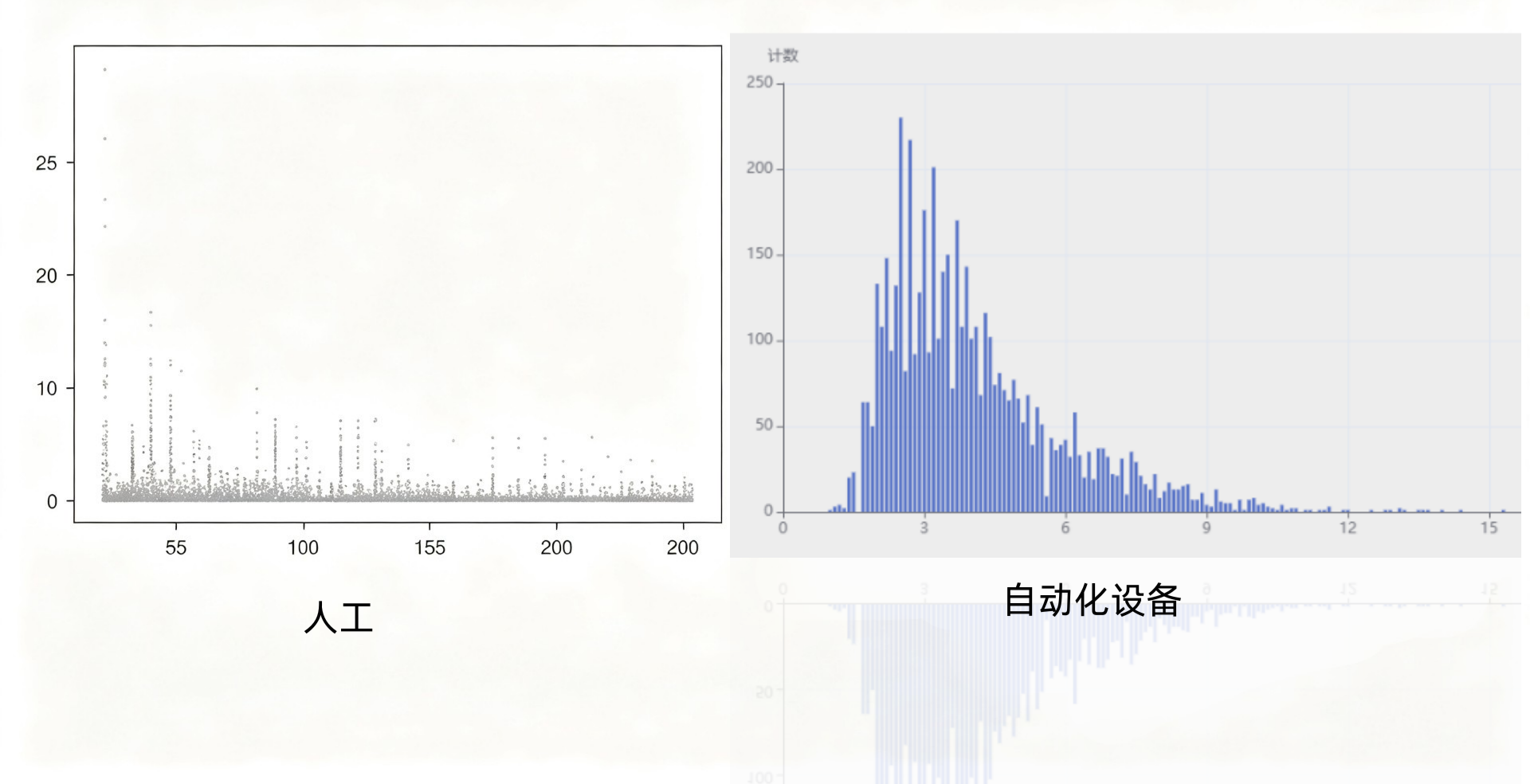
Diameter-Distribution Statistics: 25 Fibers by the Manual Method vs. 10000 by the Automated Method
Equipment Selection: Four Dimensions to Consider
As the standard approaches implementation, a wide range of fiber diameter inspection instruments is appearing on the market. How can buyers choose compliant, stable and reliable equipment? Consider the following four dimensions:
1. Participation in Standard Development
GB/T 47086-2026 was led by Nanjing Fiberglass Research & Design Institute and jointly drafted by major industry enterprises including Jushi Group, Zhenshi Group and Hangzhou Tanvint Intelligent Technology Co., Ltd. Products from participating companies were repeatedly validated during development, giving them a deeper understanding and implementation of the technical requirements. Choosing a drafting organization’s products provides reliable compliance support.
2. Hard Specifications: Precision, Speed and Throughput
Equipment performance should be assessed using data. Take Tanvint’s Smart Reinforcing Fiber Reporting System, model TW-H-20X-N-M7-LD-01, as an example:
- Software calculation precision is 0.01 μm (not whole-system measurement error). Suitability for electronic-grade glass fiber must be established through specimen preparation, calibration and reference testing;
- 10,000 fibers are measured per run, allowing large-sample statistics to reflect the true diameter distribution;
- Inspection takes 3 minutes, substantially improving efficiency over manual measurement;
- 240 samples can be loaded at once, supporting automated batch inspection;
- Multiple fiber types are supported: glass fiber, including electronic grade, basalt, alumina, quartz and carbon fiber. One unit serves multiple production lines.
3. Software Capabilities: Reporting and Data Management
The standard requires diameter-distribution information, placing significant demands on software. Qualified equipment must not only measure accurately but also report clearly: automatically generated reports, qualification decisions, traceable stored data, and export and printing. Tanvint’s system stores 1,000,000 historical reports and 20,000 digital slides to support quality traceability.
4. Genuine Automation
Some products merely add a camera to a traditional microscope and still require manual field selection, focusing and edge confirmation, limiting efficiency gains. Truly automated equipment should handle feeding, dispersion, scanning, recognition and reporting automatically. Tanvint’s system includes automatic stirring and dispersion, an automatically positioned stage and AI edge recognition, enabling one-touch inspection and a report in 3 minutes.
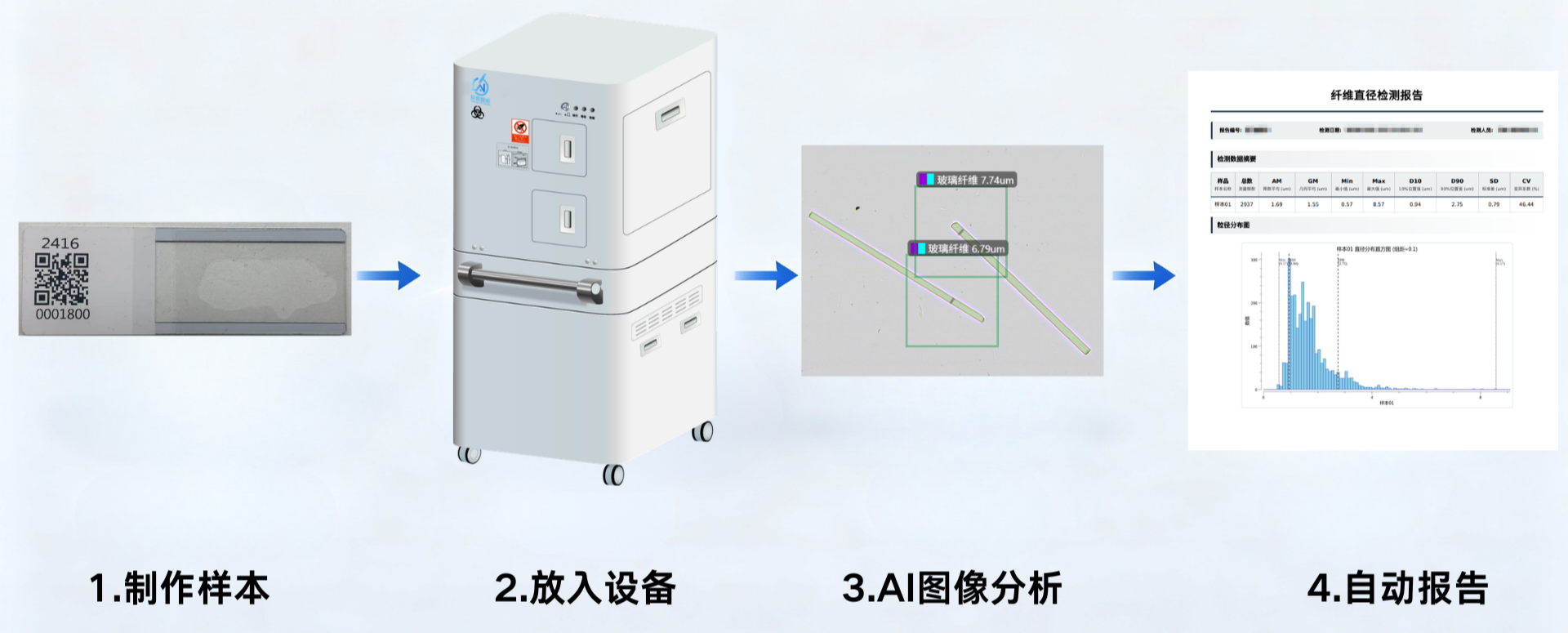
Digital Optical Scanner Inspection Workflow
Tanvint: An Inspection Solution from a Standard Drafting Organization
As a drafting organization for GB/T 47086-2026, Tanvint has continued developing automated fiber diameter inspection. Its Smart Reinforcing Fiber Reporting System is already used by multiple glass-fiber and fiber-wool manufacturers. Core features include:
- Deep participation in standard development: Equipment design aligns with the standard, reducing the compatibility risks of designing a product first and adapting it to a standard afterward.
- Software calculation precision is 0.01 μm (not whole-system measurement error). Whole-system error and repeatability must each be supported by their own test conditions and validation data, helping reduce supplier–customer data disputes and meet high-end inspection needs such as electronic-grade glass fiber.
- Substantially improved efficiency: Results in 3 minutes, batch inspection of 240 samples and large-sample statistics for 10000 fibers help bring diameter inspection from laboratories to production lines for process quality control.
- Multiple fiber types: One unit covers glass fiber, including electronic grade, basalt, alumina, quartz and carbon fiber, while also inspecting microfiber-wool products such as mineral wool and ceramic fiber wool, reducing equipment investment.
Free Sample Testing: Experience Inspection Under the New Standard
Implementation of GB/T 47086-2026 is now approaching. For manufacturers of high-precision materials such as electronic-grade glass fiber, mineral wool and ceramic fiber wool, upgrading equipment and becoming familiar with the new workflow in advance helps ensure a smooth transition in production and inspection.
Tanvint is offering free sample testing to the industry. Companies can send fiber samples and receive a report compliant with the new standard, experiencing the precision and efficiency of digital optical scanning firsthand.
The new national-standard era has arrived, and manual fiber diameter inspection is shifting toward automation. Choosing compliant automated equipment supports both compliance and stronger product-quality competitiveness.
For more product information or to request free sample testing, please contact sales.