Fabric Density Is an Essential Metric in the Textile Business
Warp and weft density measure the spacing of yarns. They influence fabric prices and are closely related to garment feel, shrinkage and seam strength. Fabric agreements specify minimum densities and acceptance forms record density values, but in the past the inspector alone often knew how those numbers had been obtained.
Tanvint’s Smart Woven Fabric Warp and Weft Density Tester, model TW-E-H-IR-01, assigns minute-scale inspection tasks to optics and algorithms. Place the fabric sample on the platform and click Start in the software; the equipment automatically images, counts and archives the results, providing visual evidence for every counted yarn.
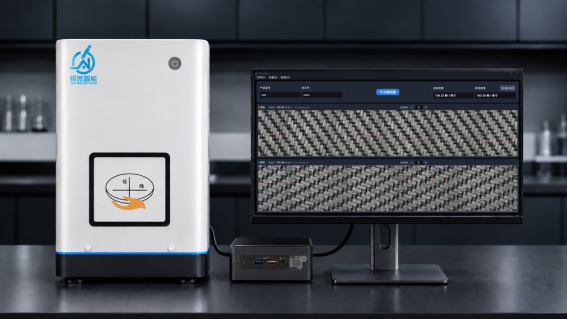
Tester, accompanying compact computer and inspection display
Why Is Density Inspection Difficult?
Traditionally, this inspection relies on a pick glass and steel ruler: a metal frame holds down the fabric, yarns are counted one by one under lighting, and a conversion factor produces the result. Looking at a few samples is easy; inspecting them daily and in batches is difficult. Changes in operator, shift or working condition can alter a result by two or three counts. In dyed fabrics, color often conceals yarn edges; dark, heavily dyed samples challenge even experienced inspectors. Manual records retain only numbers, not a reproducible counting process, making supplier–customer disagreements difficult to resolve.
The tester addresses three corresponding challenges: equipment performs measurement to reduce variation; near-infrared lighting suppresses color interference and reveals yarn contours; and image archives provide review evidence, turning isolated report numbers into retrievable records.
Three Core Advantages
[Fully Automated · High Precision]Optical microscopy acquires images, near-infrared illumination removes dye-color interference, and intelligent edge algorithms identify each yarn boundary. Counting requires no manual intervention and is precise to individual yarns.
[Multiple Weaves · Broad Compatibility]One unit covers plain, twill and satin weaves and also inspects checkered and repeating striped fabrics. Density ranges from 40 to 300 threads/inch, with a customizable inspection length of 1 to 6 cm. Repeating fabrics of any color or pattern can be inspected.
[Traceable · Easy to Review]High-definition images of every counted yarn are retained throughout the process and can be retrieved by report number. Seamless whole-specimen stitching ensures continuity across large fabric images. Inspection resumes automatically after power restoration, reports are preserved and results remain available for review.
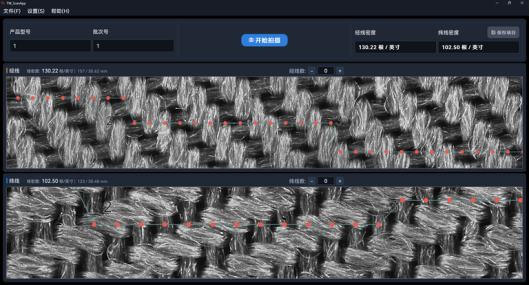
Inspection software: warp density 130.22 threads/inch and weft density 102.50 threads/inch; red dots mark counted yarns

Microscopic imaging and edge determination: individual yarn boundaries are located one by one
Technical Details Inside the Equipment
◆ Near-infrared illumination: Most dyes have similar absorption characteristics in the near-infrared range, substantially reducing color-difference interference. Dark, heavily dyed samples also produce stable light–dark contrast;
◆ Intelligent edge algorithms: Yarn contours are extracted at pixel level, and interlacing patterns identify obscured regions. Twill floats and long satin floats have little effect on counting;
◆ High-resolution imaging: Scanning resolution is 1.61 μm/pixel or better. Optical 2× magnification combined with digital 100× magnification keeps yarn gaps clearly visible in fine, dense fabrics;
◆ Seamless whole-specimen stitching: Multiple microscopic frames are aligned automatically into a continuous large image, retaining both pattern direction and local detail;
◆ Automatic recovery after power failure: Inspection resumes from the interruption point when power returns, retaining data and images and keeping reports valid. The supply range extends to AC220V±15%, 50/60 Hz;
◆ Metrological traceability: Equipment is calibrated and certified by an independent metrology organization, providing a traceable basis for measured values. Technical documents are updated alongside product development.
Specifications
| Technical Requirement | Technical Specification |
| Inspection Object | Single-layer woven fabric without hidden yarns |
| Fabric Sample | Rectangular or circular fabric pieces measuring 6 to 8 cm |
| Inspection Length | 1 to 6 cm, customizable |
| Density Range | 40 to 300 threads/inch |
| Scanning Resolution | ≤1.61 μm/pixel |
| Tolerance | At 150 threads/inch, counting error does not exceed 0.5 threads |
| Supported Textures | Plain, twill, satin, checkered and repeating striped fabrics |
| Magnification | Optical 2× / digital 100× |
| Inspection Time | Approximately 30 seconds/inch |
| Operating Software | Windows |
| Power Supply Range | AC220V±15%,50/60 Hz |
| Equipment Model | TW-E-H-IR-01 |
Applications
◆ Weaving mills: Sample inspection of greige fabric as it leaves the loom captures density fluctuations immediately and narrows the scope of rework;
◆ Dyeing and finishing plants: Incoming greige fabric is inspected in both directions, providing data for dye and chemical quantities and finishing parameters;
◆ Fabric wholesalers: New arrivals are inspected immediately, with image archives sent to downstream buyers alongside quotations;
◆ Garment and home-textile manufacturers: Incoming acceptance follows supply agreements, with illustrated records supporting negotiations and after-sales handling;
◆ Inspection organizations and textile colleges: Standardized measurement and reviewable reports support verification and sampling and can serve as a teaching demonstration platform.
From Individual Craft to System Capability
From pick glasses to microscopic imaging, and from manual to algorithmic counting, warp and weft density inspection is evolving from individual skill into reproducible system capability. Common measurement standards, recorded processes and verifiable results allow quality information to pass accurately between companies and throughout supply chains.
Guided by its brand proposition, “Exploring Technology, Boundless Microscopy,” Tanvint focuses on intelligent inspection solutions for the fabric industry. The Smart Woven Fabric Warp and Weft Density Tester is now open to nationwide distribution partnerships. Dealers and agents in textile-industry clusters are welcome to inquire through the official website’s online contact form.