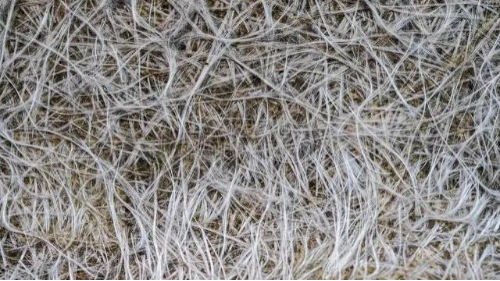
In modern industry, glass fiber is a seemingly delicate material with enormous potential. These inorganic, nonmetallic fibers, measuring 5-20 micrometers in diameter, play irreplaceable roles in several key fields thanks to their distinctive physical and chemical properties. This article explores this micrometer-scale industrial marvel through material characteristics, inspection technologies, and industrial applications.
I. The Material Characteristics and Development of Glass Fiber
1. The Process Journey from Melting to Forming
Glass fiber production begins with high-temperature melting: quartz sand (SiO₂), feldspar (KAlSi₃O₈), borax (Na₂B₄O₇), and other raw materials are mixed in specified proportions and melted into a uniform glass melt in a platinum crucible at 1500-1600℃. The melt is then drawn through precision-machined bushings containing hundreds of micrometer-scale holes at 1000-3000 meters / minute, forming individual filaments as it cools in air. This process demands extremely precise temperature control: a fluctuation of just 1℃ can affect fiber diameter uniformity.
2. Technical Breakthroughs over Seventy Years of Development
1. 1938: Owens-Corning in the United States first achieved industrial glass fiber production, initially using it mainly to replace asbestos as an insulating material.
2. 1960s: Electronic-grade E glass (Electrical Glass) was successfully developed, driving a revolution in the printed circuit board industry.
3. 1980s: High-strength S glass (Strength Glass) emerged, with tensile strength exceeding 3500 MPa to meet demanding aerospace requirements.
4. Since the 21st Century: As 5G communications, new-energy vehicles, and other fields developed, technology for producing ultrafine glass fibers with diameters of 5-7 micrometers became a major research focus.
II. How Microscopic Structure Determines Macroscopic Performance
1. The Central Influence of Diameter
Glass fiber diameter distribution directly affects three key properties:
• Mechanical Properties: Each 1-micrometer reduction in filament diameter increases tensile strength by approximately 5%, but excessively fine diameters increase filament breakage during production.
• Forming Processes: In composite production, fibers with a diameter of 12 micrometers have optimal resin wettability. Coarser fibers tend to develop interfacial defects, while finer fibers increase fabric production costs.
• Electrical Properties: Diameter uniformity for fibers used in high-frequency circuit boards must be controlled within ±0.3 micrometers; otherwise, signal transmission losses increase significantly.
2. Defect Types and Inspection Challenges
Common fiber defects in actual production include:
| Defect Type | Cause | Effect on Performance | Recognition Rate in Traditional Inspection |
| Diameter Fluctuation | Uneven Bushing Temperature | Variation in Composite Strength | Manual inspection only identifies deviations >10%. |
| Surface Contamination | Residual Drawing Oil | Poor Resin Wetting | Microscopic observation can miss contaminants <5 μm. |
| Abnormal Morphology | Abrupt Changes in Cooling Rate | Stress Concentration Points | Manual identification accuracy for curved fibers is <60%. |
III. The Iterative Development of Inspection Technology
1. Technical Limitations of Traditional Inspection
1. Statistical Bias in Sampling Inspection: Manual sampling typically selects 100-200 fibers, only 5%-10% of the total in a bundle, and cannot reflect the material's true overall quality distribution.
2. Measurement Errors from Subjective Judgment: Inspectors differ by 0.5-1 micrometers when selecting effective measurement segments on curved fibers, with repeatability accuracy of only ±1.2 micrometers.
3. Efficiency Bottlenecks: A complete inspection report takes 4-6 hours, making it difficult to meet modern production lines' real-time quality monitoring needs.
2. Technical Advantages of Intelligent Inspection Systems
To address the shortcomings of traditional inspection, next-generation measurement systems combine several technologies to achieve breakthroughs:
1. Fully Automated Workflow: High-precision line-scan cameras and motion-control platforms enable 24-hour unattended inspection, processing more than 200 samples per day and improving efficiency by more than 10 times compared with manual inspection.
2. Whole-Sample Data Analysis: Machine-vision algorithms measure more than 2000 individual filaments in a bundle, creating a quality database containing more than 30 parameters, including diameter, roundness, and defect rate.
3. Intelligent Defect Recognition: A deep-learning interference filtering model automatically identifies 10 abnormal forms, including contamination, breakage, and stacking, excludes invalid fibers from calculations, and achieves recognition accuracy above 99%.
4. High-Precision Measurement Assurance: Multiple error-correction technologies, including temperature compensation and optical-path calibration, keep errors between repeated measurements of the same sample within 0.2 micrometers, meeting stringent requirements for electronic-grade fibers.
IV. In-Depth Applications across Multiple Fields
1. Core Support for Electronics and Information Technology
Glass fiber plays a key role in 5G communications equipment:
• PCB Substrates: Ultrathin glass fiber fabric only 0.1 mm thick serves as an insulation layer, requiring filament diameter uniformity <0.5 micrometers to reduce signal transmission losses.
• Chip Packaging: Ultrafine fibers with a diameter of 7 micrometers produce composites with high thermal conductivity, addressing heat dissipation challenges in 5G chips.
2. Innovative Applications in New Energy
1. Wind Turbine Blades: Glass fiber composites used in hundred-meter-class blades must pass 2 million fatigue-test cycles. Fiber diameter uniformity directly affects fatigue life.
2. Photovoltaic Modules: Glass fiber mesh used in solar cell encapsulation requires weather resistance exceeding 25 years; special surface treatment improves UV resistance.
3. A Key Material for Lightweight Transportation
Glass fiber composites bring significant benefits to automotive manufacturing:
• Body Components: Compared with traditional steel, glass fiber reinforced plastics reduce weight by 30%-50% and lower fuel consumption by 8%-15% in equivalent vehicle models.
• Safety Structures: Crash beams made with high-strength glass fibers absorb more than 30% of impact energy during collisions, improving passive safety.
V. Future Directions for Industrial Development
1. Material Research Trends
1. Ultrafine Diameters: Targets fibers with diameters of 3-5 micrometers to meet the needs of next-generation high-frequency, high-speed circuit boards.
2. Multifunctional Composites: Develops glass fibers combining electrical and thermal conductivity to expand applications in intelligent equipment.
3. Green Manufacturing: Promotes environmentally friendly fluorine-free and boron-free formulations to reduce pollutant emissions during production.
2. Evolution of Inspection Technology
As Industry 4.0 advances, intelligent inspection systems are achieving new breakthroughs:
• Cloud Quality Platforms: The industrial internet synchronizes inspection data in real time across factories, building a quality database covering the entire industry chain.
• AI Prediction Models: Prediction algorithms trained on historical inspection data warn of production quality fluctuations 4 hours in advance.
• Portable Equipment: Handheld intelligent inspection instruments support rapid on-site sampling, shortening inspection time to 5 minutes / sample.
Conclusion
The history of glass fiber is one of mutual advancement between materials science and inspection technology. From its original role as an insulating material to its present role as a key foundation for high-end manufacturing, every advance has accompanied improvements in inspection precision. When intelligent measurement systems move from sampling 200 fibers to inspecting all 2000, and diameter measurement errors improve from 1 micrometer to 0.2 micrometers, we see more than optimized technical parameters: we see an entire industry advancing steadily toward precision manufacturing.
Under the new “dual circulation” development pattern, the glass fiber industry faces new opportunities and challenges. Sustained technological innovation that jointly advances material performance and inspection technology will strongly support China's breakthroughs in high-end composites. This seemingly delicate industrial yarn is weaving a new chapter in high-quality manufacturing development with micrometer precision.
(The technical data in this article come from publicly available industry reports and enterprise technical materials. Consult a professional technical institution for a specific inspection solution.)